
Next.js vs. React: Choosing the Right Framework for Modern Business Applications
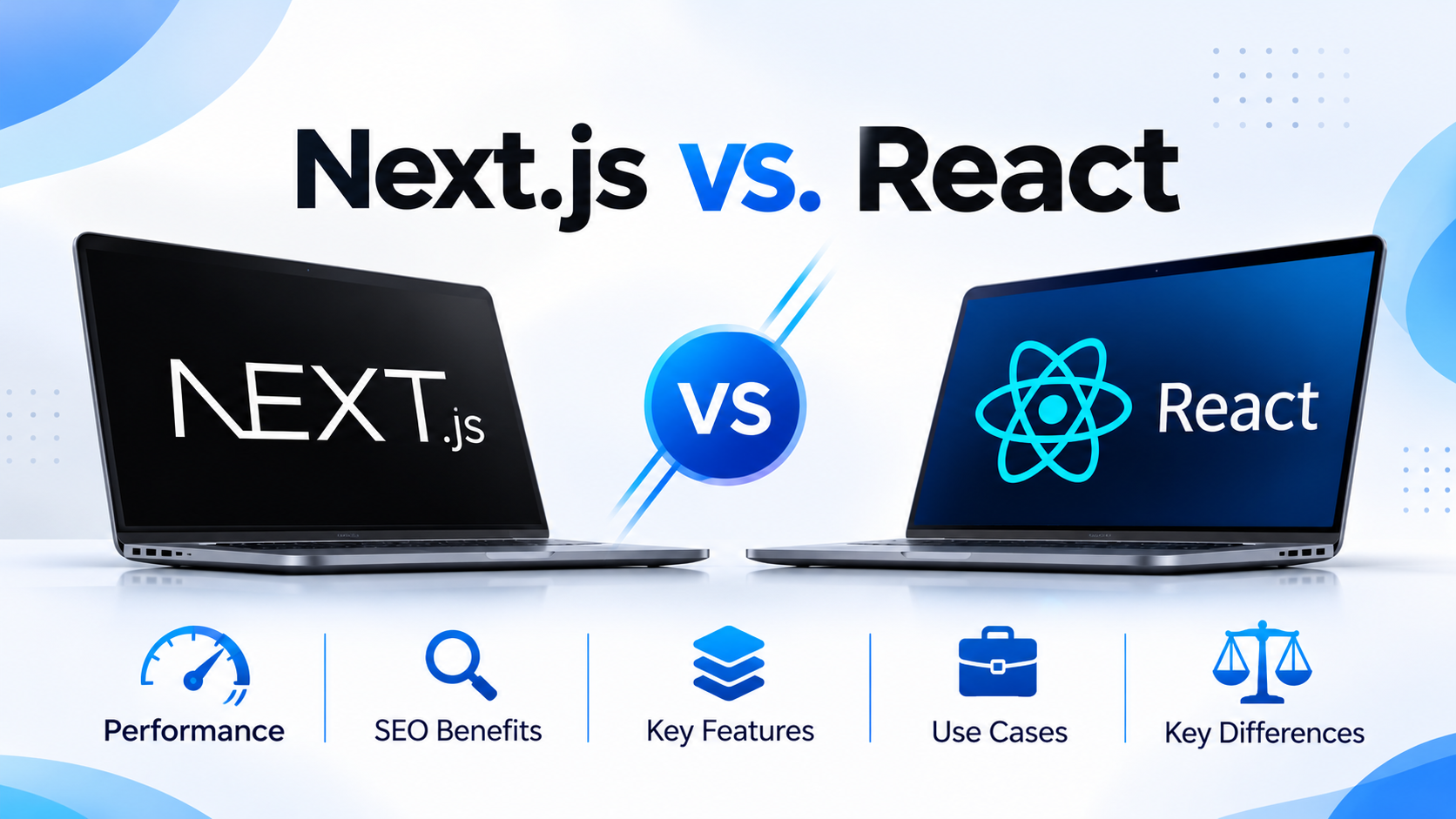
Choosing the right technology is an important decision when building a modern business application. The technology stack affects application performance, scalability, user experience, development time, and long-term maintenance. Among the popular choices for frontend development, React and Next.js are frequently considered by businesses planning websites, dashboards, customer portals, and enterprise applications.
However, comparing Next.js and React is slightly different from comparing two competing frameworks. React is a JavaScript library for building user interfaces, while Next.js is a React-based framework that provides additional features for developing full-stack web applications.
Both technologies can support modern business applications, but they serve different development needs. Understanding their differences can help organizations select an approach that matches their application requirements and growth plans.
What Is React?
React is an open-source JavaScript library used to build interactive user interfaces through reusable components. It allows developers to divide an application into smaller UI elements that can be independently developed, maintained, and reused.
For example, a business dashboard might contain components for navigation, customer records, charts, notifications, and reports. Developers can build these elements separately and combine them to create a consistent application experience.
React primarily focuses on the user interface. Developers typically choose additional tools or libraries for routing, data fetching, application structure, and other requirements.
Key Features of React
- Component-based architecture: Build reusable UI components that simplify development and maintenance.
- Virtual DOM: React uses its rendering model to update the user interface efficiently when application data changes.
- One-way data flow: Helps developers manage how information moves through application components.
- Large ecosystem: Provides access to libraries, tools, and community resources.
- Flexible development: Developers can select supporting technologies based on project requirements.
React is a suitable choice for interactive dashboards, single-page applications, internal business tools, and applications where teams want flexibility over the frontend architecture.
What Is Next.js?
Next.js is a React framework designed to support the development of full-stack web applications. It builds on React and provides additional capabilities such as routing, server-side rendering, static generation, server components, and performance optimizations.
Instead of configuring every supporting tool independently, developers can use Next.js conventions and built-in features to organize and develop an application.
Its App Router supports layouts, nested routes, Server Components, Client Components, and other modern application-development capabilities.
Key Features of Next.js
- File-based routing: Application routes can be created through the folder and file structure.
- Server-side rendering: Pages can be rendered on the server when the application requires it.
- Static generation: Suitable pages can be generated ahead of time and served as static content.
- Server Components: Allow suitable components to render on the server, supporting data access and reduced client-side JavaScript.
- API and server capabilities: Developers can implement backend functionality through route handlers and server-side features.
- Performance optimization: Provides built-in support for features such as image optimization, font optimization, and route prefetching.
- Metadata management: Supports page metadata and social-sharing information.
These capabilities make Next.js useful for business websites, SaaS platforms, customer portals, content-driven applications, and more complex web products.
Next.js vs. React: Key Differences
Although Next.js uses React, the two technologies offer different levels of functionality and development structure.
| Comparison Factor | React | Next.js |
|---|---|---|
| Technology type | JavaScript UI library | React-based framework |
| Primary purpose | Building user interfaces | Building full-stack web applications |
| Routing | Requires an additional routing solution | Built-in file-based routing |
| Rendering | Commonly client-side, with other approaches available through additional tools | Supports server, static, and client rendering |
| Backend functionality | Requires separate tools or services | Provides server-side capabilities |
| SEO implementation | Requires additional rendering and optimization planning | Offers built-in rendering and metadata features |
| Development flexibility | High flexibility in choosing tools | More structured development conventions |
| Best suited for | Interactive interfaces and SPAs | Full-stack applications and content-driven websites |
The important distinction is that Next.js does not replace React. It uses React as its foundation and adds features that help developers build and deploy complete applications.
Performance and SEO: Which Is Better?
Performance and search visibility are important considerations for businesses developing public-facing websites and web applications.
React Performance
React can deliver highly interactive user experiences. However, a client-rendered React application may require the browser to download and execute JavaScript before displaying certain content.
Developers can improve performance through code splitting, lazy loading, caching, optimized assets, and appropriate rendering strategies. Server rendering can also be introduced through a suitable framework or supporting architecture.
Next.js Performance
Next.js provides multiple rendering approaches, allowing developers to select an appropriate strategy for different pages.
For example:
- Static pages can be generated ahead of time.
- Dynamic pages can be rendered on the server.
- Interactive components can run on the client.
- Server Components can handle suitable data-fetching operations without adding their code to the client-side JavaScript bundle.
Next.js also includes optimization features for images, fonts, and navigation.
For websites that depend heavily on organic search traffic, server rendering and static generation can make important page content available in the initial HTML. However, neither framework automatically guarantees high search rankings or excellent performance. Results depend on implementation, content quality, hosting, and optimization.
Common Business Use Cases of React
React is particularly useful when businesses need flexible, interactive user interfaces.
1. Business Dashboards
Companies can use React to develop dashboards that display sales figures, operational metrics, customer information, and performance indicators.
Reusable components make it easier to maintain charts, tables, filters, and reporting interfaces.
2. Customer Relationship Management Systems
React can support CRM interfaces where employees manage customer records, update lead statuses, track interactions, and access business information.
3. Internal Business Applications
Organizations can use React to build employee portals, workflow interfaces, administrative tools, and internal management applications.
4. Single-Page Applications
React is well suited to applications where users interact with multiple sections without requiring full-page reloads, such as project management tools and operational dashboards.
Common Business Use Cases of Next.js
Next.js is useful when a business needs React-based interfaces along with routing, server-side functionality, and flexible rendering.
1. SaaS Applications
Businesses developing subscription-based software can use Next.js for customer dashboards, account management, onboarding pages, and other application interfaces.
Its routing and server capabilities can help organize larger applications as their functionality grows.
2. Business Websites and Web Portals
Next.js can support company websites, customer portals, and content-driven platforms where search visibility and page-loading performance matter.
3. E-Commerce Applications
Businesses can use Next.js to build product pages, category pages, shopping experiences, and server-connected application features.
Its rendering options can help deliver product information efficiently while supporting interactive shopping components.
4. Enterprise Web Applications
Next.js can be used for enterprise applications that combine public-facing pages, authenticated user areas, dashboards, and server-side operations.
The architecture should still be planned carefully when the application requires complex permissions, integrations, and business workflows.
Advantages and Limitations of Both Technologies
Every technology has trade-offs. The right choice depends on the project's requirements and the development team's experience.
React: Advantages
- Flexible architecture and technology selection.
- Large developer ecosystem.
- Reusable components support maintainability.
- Suitable for highly interactive user interfaces.
- Can be integrated into existing applications.
React: Limitations
- Routing and other application features require additional tools.
- Developers must make more architectural decisions.
- SEO and server rendering need additional planning.
- Managing a large application requires consistent development conventions.
Next.js: Advantages
- Built-in routing and application structure.
- Multiple rendering strategies.
- Integrated server-side capabilities.
- Useful optimization and metadata features.
- Suitable for applications that combine content and interactivity.
Next.js: Limitations
- Requires developers to understand both React and framework-specific concepts.
- Server and client component boundaries can introduce complexity.
- Caching and rendering behavior need careful configuration.
- Framework conventions may limit some architectural choices.
- Deployment and hosting requirements can be more involved than a simple static React application.
How to Choose Between Next.js and React
Before selecting a technology, businesses should evaluate their application requirements rather than choosing based only on popularity.
Consider the following factors:
- Application Type: If the project mainly requires an interactive user interface or internal dashboard, React may be sufficient. If it needs integrated routing, server-side functionality, and multiple rendering strategies, Next.js may be a better fit.
- SEO Requirements: Public-facing websites and content-heavy platforms may benefit from Next.js rendering and metadata capabilities.
- Application Complexity: Consider how many modules, user roles, integrations, and business workflows the application will need.
- Development Expertise: Evaluate the team's experience with React, Next.js, backend development, and deployment. Businesses looking to build interactive dashboards, customer portals, or single-page applications can hire affordable React developers to develop reusable components and flexible user interfaces that align with their application requirements.
- Long-term Scalability: Plan for future features, increased usage, application maintenance, and integration requirements. For projects that require server-side rendering, structured routing, and scalable web application architecture, businesses can hire affordable Next.js Developers India to build modern applications with performance and future growth in mind.
- Budget and Timeline: Compare the overall development and maintenance effort rather than focusing only on initial implementation speed.
For businesses planning a tailored application, working with experienced Next.js developers or React developers can help ensure that the technology choice aligns with the project's technical and business goals.
Can React and Next.js Be Used Together?
Yes. In fact, Next.js is built on React, so developers use React components when building Next.js applications.
A Next.js project can combine server-rendered pages with interactive React components. For example, a business website might render its service pages on the server while using client-side React components for contact forms, interactive calculators, and dashboard widgets.
This approach allows development teams to use the strengths of both technologies within one application.
Conclusion
React and Next.js are both valuable technologies for modern business application development, but they address different levels of the development process.
React provides the foundation for building reusable and interactive user interfaces. Next.js extends that foundation with routing, rendering strategies, server-side functionality, and optimization features that support complete web applications.
For businesses developing focused interactive tools, React may provide the flexibility they need. For projects involving public-facing content, SEO requirements, server-side operations, and more structured application architecture, Next.js may be the stronger option.
Ultimately, the right choice depends on the application's functionality, performance expectations, development resources, and long-term goals. A well-planned architecture matters more than selecting a technology simply because it is popular.
Frequently Asked Questions
1. Is Next.js better than React?
Neither is universally better. React is a UI library, while Next.js is a framework built on React. The right choice depends on the application's rendering, routing, backend, and customization requirements.
2. Is Next.js easier to develop with than React?
Next.js provides built-in conventions and features that can simplify certain development tasks. However, developers need to understand its routing, rendering, server components, and caching concepts.
3. Can React be used for large business applications?
Yes. React can support large business applications, including CRM systems, dashboards, and enterprise interfaces. The project needs a suitable architecture and supporting tools.
4. Is Next.js suitable for SaaS development?
Yes. Next.js can support SaaS applications with features such as user dashboards, account pages, server-side functionality, and public-facing content. Backend architecture, authentication, billing, and data management still need to be designed appropriately.
5. Can an existing React application be migrated to Next.js?
Yes. Existing React applications can be migrated progressively. The effort depends on the current routing setup, rendering approach, integrations, and application architecture.
About the author
- LnP Infotech Pvt. Ltd. is an AI technology consulting and digital solutions company based in Mohali, India, serving businesses worldwide. Founded in 2018, we specialize in custom software development, AI solutions, automation, web and mobile app development, SaaS solutions, and technology consulting. Our expertise includes finance and healthcare software, real estate technology, reporting and analytics, digital transformation, and business process automation. We help businesses modernize legacy systems, streamline operations, improve efficiency, and build scalable digital products tailored to their requirements. With an experienced technology team and a practical, future-ready approach, LnP Infotech delivers reliable software and technology solutions that support sustainable business growth.
Comments
Join the discussionNo comments yet. Be the first to comment.