
Multi-Agent AI Systems: How Multiple AI Agents Work Together in Business
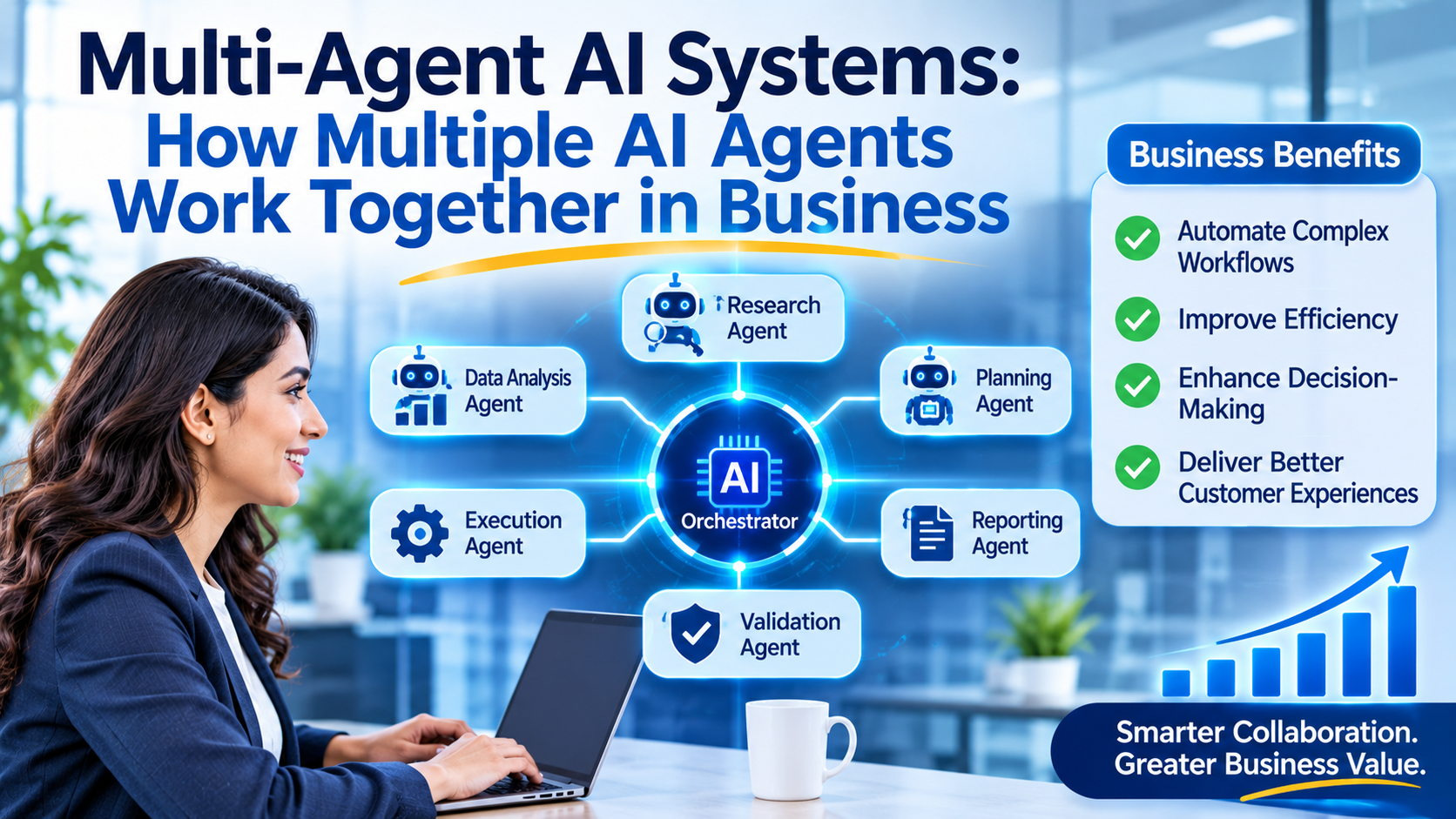
Businesses are increasingly using artificial intelligence to automate repetitive tasks, analyze information, improve customer experiences, and support faster decision-making. However, as business operations become more complex, a single AI assistant may not be enough to handle every task effectively.
This is where multi-agent AI systems come into play.
Instead of relying on one AI model to perform an entire workflow, a multi-agent system uses multiple specialized AI agents that collaborate to complete tasks. Each agent has a specific responsibility, such as gathering information, analyzing data, preparing recommendations, or executing an approved action.
For businesses, this approach creates opportunities to automate complex workflows involving multiple departments, applications, and decision-making steps.
In this article, we explore how multi-agent AI systems work, their business applications, key benefits, implementation challenges, and how organizations can start building them.
What Are Multi-Agent AI Systems?
A multi-agent AI system is a software architecture in which multiple AI agents collaborate to achieve a shared goal. Each agent is assigned a particular role and can perform tasks using its own instructions, tools, data sources, and capabilities.
Unlike a traditional AI chatbot that primarily responds to individual prompts, a multi-agent system can divide a complex objective into smaller tasks, assign those tasks to specialized agents, and combine their results.
For example, imagine an organization wants to analyze its monthly sales performance and prepare a business report. A multi-agent system could include:
- Data Collection Agent: Retrieves sales information from business databases.
- Analysis Agent: Identifies revenue trends, performance gaps, and patterns.
- Research Agent: Collects relevant market and competitor information.
- Reporting Agent: Prepares a structured report with charts and insights.
- Review Agent: Checks the report for missing information and inconsistencies.
A coordinating agent or orchestration layer manages the workflow and ensures that individual tasks contribute to the overall objective.
How Do Multiple AI Agents Work Together?
Multi-agent systems typically follow a structured workflow. Although the exact architecture varies, the process generally includes the following stages.
1. Goal Identification
The system receives a business objective, such as processing a customer request, reviewing supplier performance, or preparing a financial report.
An orchestrator interprets the request and determines which agents and tools are needed.
2. Task Distribution
The orchestrator divides the objective into smaller tasks and assigns them to specialized agents.
For example, when processing a customer order, one agent may check product availability, another may validate customer information, and another may prepare the order details.
3. Independent Task Execution
Each agent performs its assigned responsibility using relevant data, business rules, and connected tools.
Some agents may retrieve information, while others analyze results, generate content, or interact with business applications.
4. Agent Communication and Collaboration
Agents exchange information through defined communication channels or shared context.
The output of one agent can become the input for another. For example, a research agent may provide information to an analysis agent, which then passes its findings to a reporting agent.
5. Result Validation
A review or verification agent checks whether the results meet the required standards.
Depending on the task, validation may include checking calculations, confirming required fields, comparing information against business rules, or identifying incomplete outputs.
6. Final Output or Action
Once the workflow is complete, the system presents the result or performs an authorized action.
High-impact actions, such as approving payments, changing customer records, or issuing contracts, should require appropriate human approval.
Common Types of AI Agents in a Multi-Agent System
Different agents can be designed for different responsibilities. Some common types include:
| Agent Type | Primary Responsibility |
|---|---|
| Coordinator Agent | Assigns tasks and manages workflow execution |
| Research Agent | Collects information from approved sources |
| Data Analysis Agent | Examines data and identifies patterns |
| Customer Support Agent | Handles customer questions and requests |
| Planning Agent | Creates task sequences and execution plans |
| Execution Agent | Performs approved actions through connected tools |
| Monitoring Agent | Tracks progress and identifies issues |
| Validation Agent | Reviews outputs for accuracy and completeness |
Not every business needs all these agents. The architecture should be based on actual workflow requirements rather than the number of agents a platform can support.
Business Applications of Multi-Agent AI Systems
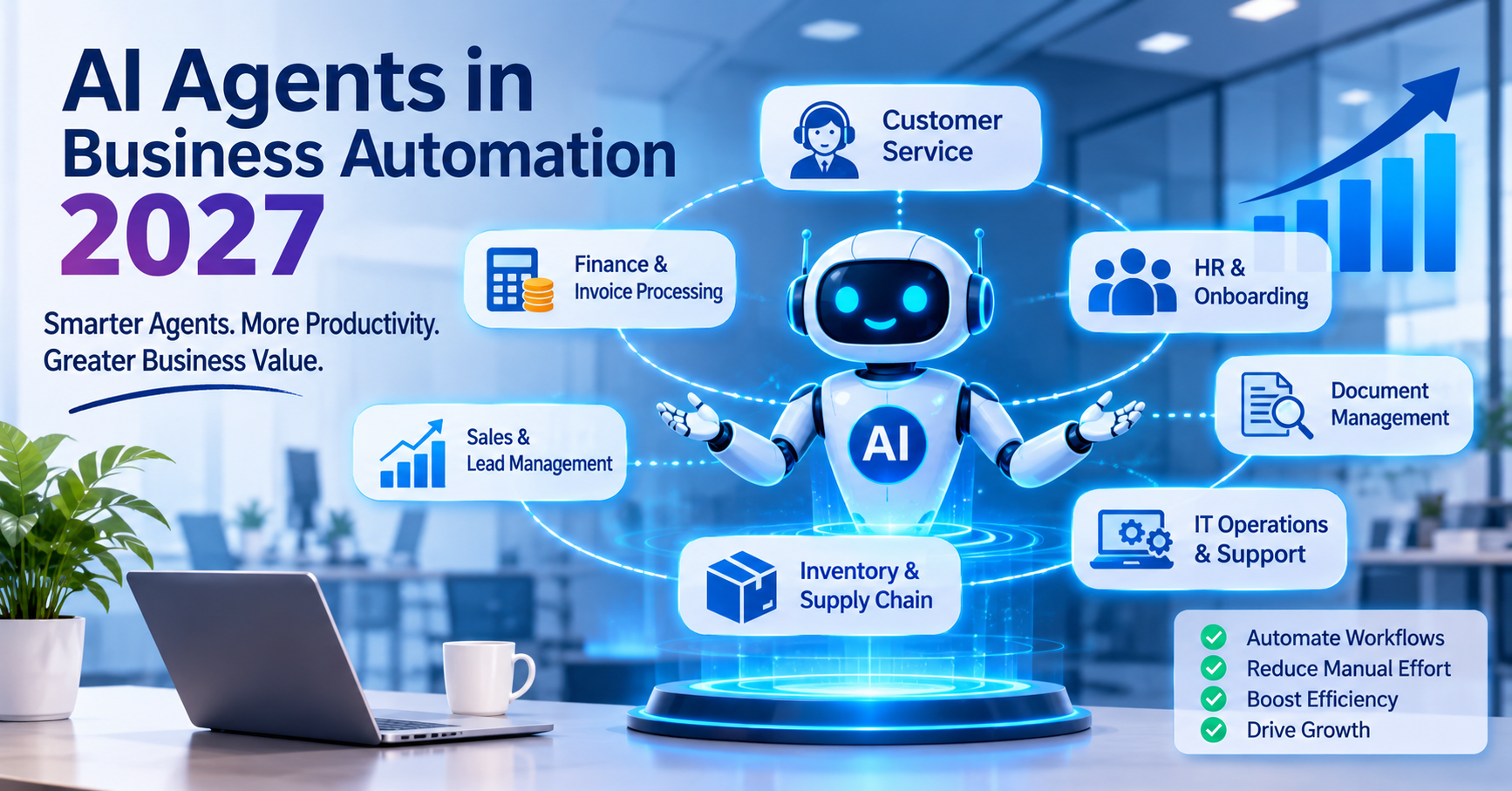
Multi-agent AI systems can support several business functions, particularly where processes involve multiple steps, information sources, or departments.
1. Customer Support Automation
Customer support often requires more than answering a question. A request may involve checking an order, reviewing account information, identifying a technical issue, and arranging a resolution.
A multi-agent workflow can divide these responsibilities:
- A classification agent identifies the customer's issue.
- An information agent retrieves relevant account or order details.
- A resolution agent recommends an appropriate solution.
- A response agent prepares the customer communication.
- A review agent checks the response before it is sent.
This can help support teams manage complex requests more efficiently while escalating sensitive or unusual cases to human employees.
2. Sales and Lead Management
Sales teams receive leads through websites, campaigns, referrals, and other channels. Evaluating and following up with every lead manually can consume considerable time.
A multi-agent system can support the process by:
- Collecting lead information.
- Checking lead completeness.
- Analyzing potential customer requirements.
- Categorizing leads based on predefined criteria.
- Preparing personalized follow-up messages.
- Updating CRM records through authorized integrations.
Sales representatives can then focus on qualified opportunities and relationship building.
3. Finance and Invoice Processing
Finance departments handle invoices, payment records, expense information, and approval workflows.
Specialized agents can extract invoice details, compare them with purchase orders, identify discrepancies, and prepare records for review.
For example, an invoice-processing workflow could use one agent to extract information, another to validate amounts, and a third to check whether required approvals are available.
Financial approvals and payment execution should remain subject to defined authorization rules and human oversight.
4. Supply Chain and Inventory Management
Supply chain operations involve suppliers, inventory levels, purchase orders, delivery schedules, and demand forecasts.
Multi-agent AI can help coordinate these activities.
An inventory agent can monitor stock levels, a forecasting agent can analyze demand, and a supplier agent can retrieve delivery information. A coordinating agent can combine these findings and recommend replenishment actions.
This can help businesses identify potential shortages and make more informed purchasing decisions.
5. Human Resources and Employee Operations
HR departments manage recruitment, onboarding, employee queries, training, and internal documentation.
A multi-agent system can assist with:
- Screening applications against predefined job requirements.
- Scheduling interviews.
- Preparing onboarding checklists.
- Answering common employee questions.
- Finding relevant training resources.
- Organizing HR documentation.
Decisions that affect hiring, employee evaluation, compensation, or other sensitive matters should remain subject to appropriate human review.
6. Software Development and IT Operations
Multi-agent systems can also support software development workflows.
For example, a development workflow may involve:
- A planning agent that breaks down a feature request.
- A coding agent that prepares implementation changes.
- A testing agent that runs relevant test cases.
- A review agent that checks code quality and potential issues.
- A documentation agent that updates technical documentation.
Human developers should review important changes before they are merged or deployed, particularly when production systems are involved.
Multi-Agent AI Systems vs. Single-Agent AI Systems
Both approaches can be useful, but they serve different requirements.
| Comparison | Single-Agent AI | Multi-Agent AI |
|---|---|---|
| Structure | One agent handles the task | Multiple specialized agents collaborate |
| Task complexity | Suitable for focused workflows | Suitable for complex, multi-step workflows |
| Responsibilities | Managed by one agent | Divided among specialized agents |
| Coordination | Usually simpler | Requires orchestration and communication |
| Maintenance | Easier for small applications | Requires monitoring of multiple components |
| Cost | Often lower for simple tasks | Can be higher due to multiple model calls |
| Scalability | Depends on the agent's design | Individual agents can be expanded or modified |
A single-agent solution may be sufficient for answering FAQs or summarizing documents. A multi-agent architecture becomes more useful when a process requires specialized responsibilities, multiple tools, or coordination across business functions.
More agents do not automatically produce better results. The architecture should solve a genuine workflow problem.
Key Benefits of Multi-Agent AI Systems for Businesses
Improved Workflow Automation
Agents can handle different stages of a process and pass results between one another, reducing repetitive manual work.
Specialized Task Handling
Each agent can be configured for a specific responsibility, allowing workflows to use different instructions, tools, and knowledge sources.
Greater Flexibility
Businesses can modify or replace individual agents without necessarily redesigning the entire system.
Better Use of Business Data
Agents can retrieve and analyze information from approved databases, documents, and enterprise applications to support more informed decisions.
Faster Process Coordination
Parallel task execution can reduce delays when independent activities can happen at the same time.
Support for Business Growth
A well-designed architecture can accommodate additional workflows, users, and integrations as business requirements evolve.
However, these benefits depend on effective coordination, reliable data, suitable models, and appropriate governance.
Challenges of Implementing Multi-Agent AI Systems
Although multi-agent systems offer useful capabilities, businesses should understand the challenges before adopting them.
1. Complex Agent Coordination
Agents may misunderstand instructions, produce incompatible outputs, or fail to pass information correctly.
How to address it: Define clear agent responsibilities, structured communication formats, task boundaries, and workflow rules.
2. Inaccurate or Conflicting Outputs
An incorrect result from one agent can influence the work of other agents. Errors may spread through the workflow if outputs are not validated.
How to address it: Introduce verification steps, source checks, confidence thresholds, and human review for important decisions.
3. Data Security and Access Control
Agents may interact with business databases, customer records, internal documents, and third-party applications.
How to address it: Apply least-privilege permissions, secure authentication, data encryption, activity logging, and restrictions on sensitive information.
4. Higher Infrastructure and Operating Costs
Multiple agents may require repeated model calls, API requests, and additional processing resources.
How to address it: Use smaller models for simpler tasks, limit unnecessary agent interactions, set execution budgets, and monitor usage.
5. Difficulties in Monitoring and Accountability
When several agents contribute to a result, identifying the source of an error can become challenging.
How to address it: Maintain execution logs, record agent decisions and tool calls, and define clear ownership for every workflow.
How to Implement a Multi-Agent AI System in Your Business
A successful implementation begins with a clear business problem. The following steps can help organizations move from an idea to a working solution.
Step 1: Identify a Suitable Business Workflow
Start by identifying a process that involves several related tasks and creates significant manual effort.
Examples include customer request processing, invoice validation, sales lead qualification, and internal reporting.
Avoid introducing multiple agents into a workflow that can be handled effectively with a simple automation or single AI assistant.
Step 2: Define Agent Responsibilities
Break the selected workflow into smaller responsibilities.
Determine which tasks require research, analysis, planning, execution, and validation. Assign each responsibility to an agent with a clearly defined scope.
Step 3: Choose the Right AI Models and Tools
Select models based on task complexity, response quality, processing requirements, cost, and data-handling policies.
Agents may also need access to databases, document repositories, business APIs, and internal applications.
Businesses looking to build specialized AI-powered applications can explore Hire Affordable AI specialist India to support the development of intelligent workflows and agent-based solutions.
Step 4: Design the Orchestration Architecture
The orchestration layer manages how agents communicate, receive tasks, share information, and return results.
Define:
- Task assignment rules.
- Agent communication protocols.
- Shared context and memory requirements.
- Execution order and dependencies.
- Retry and error-handling mechanisms.
- Validation and escalation procedures.
Step 5: Integrate Business Applications
Connect the system with the applications required for the workflow, such as CRM, ERP, accounting, inventory, or customer support platforms.
Use secure APIs and controlled permissions to exchange information. Businesses can work with a Hire Third Party API Integration Specialist to connect AI agents with existing enterprise applications and maintain reliable data exchange.
Step 6: Establish Security and Governance
Define which information agents can access and which actions they are allowed to perform.
Set approval requirements for sensitive operations, maintain audit trails, and establish clear procedures for stopping or escalating unexpected behavior.
Step 7: Test the Complete Workflow
Test individual agents as well as the entire system.
Check whether agents interpret instructions correctly, share information accurately, handle failures, and complete the intended business objective.
Also test unusual inputs, conflicting results, unavailable services, and unauthorized action attempts.
Step 8: Deploy, Monitor, and Improve
Start with a limited workflow or department before expanding the system.
Monitor completion rates, error frequency, processing time, operating costs, and employee feedback. Use these findings to improve agent instructions, workflows, and integrations.
What Is the Future of Multi-Agent AI in Business?
Multi-agent AI is moving toward more connected and coordinated business workflows. Organizations are exploring systems where specialized agents work across departments and enterprise applications rather than operating as isolated assistants.
Some important developments include:
- Cross-functional AI workflows: Agents coordinating activities across sales, finance, HR, and operations.
- Improved agent interoperability: Standardized ways for agents to communicate and exchange information.
- Human-supervised autonomy: Systems that complete routine tasks independently while escalating important decisions.
- Specialized smaller models: Using task-specific models to improve efficiency and control costs.
- Stronger AI governance: Centralized monitoring of agent identities, permissions, activity, and performance.
As agent ecosystems grow, businesses will need to manage not only individual agent behavior but also the risks created by interactions between agents.
Final Thoughts
Multi-agent AI systems provide businesses with a way to coordinate specialized AI capabilities across complex workflows. By dividing responsibilities among agents, organizations can automate connected tasks, improve operational coordination, and make better use of their business data.
However, successful implementation requires more than deploying several AI models. Businesses need clear agent roles, reliable orchestration, secure integrations, continuous monitoring, and human oversight where decisions carry significant consequences.
For organizations building a complete solution around these capabilities, affordable custom software development can help bring AI agents, business workflows, and existing applications together in a platform designed around specific operational requirements.
The best approach is to begin with a specific business challenge, develop a focused multi-agent workflow, measure its performance, and expand gradually. With the right architecture and governance, multi-agent AI can become a practical part of a business's long-term digital transformation strategy.
Frequently Asked Questions (FAQs)
1. What is a multi-agent AI system?
A multi-agent AI system is a software architecture in which multiple specialized AI agents communicate and collaborate to complete a shared objective. Each agent performs a defined task under an orchestration process.
2. How do multiple AI agents communicate?
Agents communicate through structured messages, shared context, APIs, or orchestration frameworks. The communication method depends on the system architecture and the requirements of the workflow.
3. What are examples of multi-agent AI in business?
Common examples include customer support automation, invoice processing, sales lead qualification, supply chain coordination, HR operations, and software development workflows.
4. Is a multi-agent AI system better than a single AI agent?
Not always. Single-agent systems are often more suitable for simple, focused tasks. Multi-agent systems are useful when a workflow requires multiple specialized responsibilities and coordinated execution.
5. How much does it cost to build a multi-agent AI system?
The cost depends on the number of agents, model selection, workflow complexity, integrations, infrastructure, security requirements, and ongoing maintenance. A focused pilot is often a practical starting point.
6. Are multi-agent AI systems secure?
They can be designed with strong security controls, but security is not automatic. Businesses should implement access restrictions, authentication, encryption, audit logging, output validation, and human approval for sensitive actions.
About the author
- LnP Infotech Pvt. Ltd. is an AI technology consulting and digital solutions company based in Mohali, India, serving businesses worldwide. Founded in 2018, we specialize in custom software development, AI solutions, automation, web and mobile app development, SaaS solutions, and technology consulting. Our expertise includes finance and healthcare software, real estate technology, reporting and analytics, digital transformation, and business process automation. We help businesses modernize legacy systems, streamline operations, improve efficiency, and build scalable digital products tailored to their requirements. With an experienced technology team and a practical, future-ready approach, LnP Infotech delivers reliable software and technology solutions that support sustainable business growth.
Comments
Join the discussionNo comments yet. Be the first to comment.